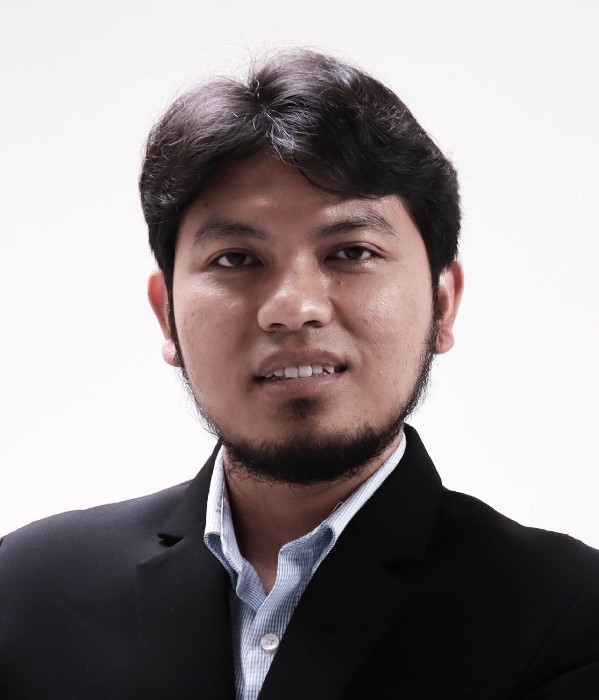
Nur Ahmadi is a lecturer and researcher at ITB's School of Electrical Engineering and Informatics, working at the intersection of AI, signal processing, and biomedical circuits & systems: from decoding brain signals to enable paralysed patients to control devices, to building wearable systems that monitor human health. His works bring a combination of signal processing and AI expertise with embedded hardware know-how to problems that genuinely matter for human health. It spans from fundamental research to real devices/systems built and tested with clinical collaborators, bridging the gap between algorithm and bedside.
Imperial College London, United Kingdom
Tokyo Institute of Technology, Japan
Institut Teknologi Bandung, Indonesia
Our group works on the following core themes
How do we translate the brain's electrical whispers into meaningful commands for machines? This research develops signal processing and AI algorithms to decode motor intention directly from neural recordings, enabling paralysed patients to control external devices (e.g. computers) with thought alone.
Continuous health monitoring shouldn't require a hospital visit. This research builds wearable and contactless systems — using photoplethysmography (PPG), remote PPG from cameras, and FMCW radar — to measure heart rate, respiratory rate, and heart rate variability unobtrusively in daily life.
Mental health conditions are vastly underdiagnosed, partly because objective monitoring tools barely exist outside clinical settings. This research develops AI-driven applications and smart wearables for mental health screening and unobtrusive home monitoring for people with dementia using edge AI.
Some healthcare applications require running AI in real time on a small, power-efficient edge device. This research focuses on hardware-software co-design including optimizing AI models for embedded deployement on FPGAs and microcontrollers (MCUs), and designing neuromorphic algorithm & system.
Recent and representative works — see Google Scholar for the full list
Latest updates from the group
New paper accepted — "Overcoming Data Scarcity In Radar-Based Human Activity Recognition: An Empirical Study of Multi-Radar Training" has been accepted at EMBC 2026 in Toronto, Canada. Preprint available soon.
Research grant awarded — Received funding for Fundamental Research Program from the Indonesian Ministry of Higher Education, Science, and Technology (Kemdiktisaintek).
Attended IEEE ISBI 2026, London — Attended and supported my student presenting a paper "Real-Time Camera-Based Heart Rate Estimation System Using Deep Learning on Edge Device".
New paper published — "Access Control Development Within the Framework of an IOTA-Based Electronic Medical Record Management System" has been published at Sensors journal.
Attended IEEE ISSCC 2026, San Francisco — Attended the conference and witnessed the awarding ceremony of my students' Code-A-Chip Award from IEEE SSCS.
Current members
PhD Student · Electrical Engineering
Master's Student · Electrical Engineering
Master's Student · Computer Science
Research Assistant · Biomedical Engineering
Courses offered at ITB
Semester 2 2025/2026 · Students learn to design and build end-to-end Internet of Things (IoT) systems from sensor interfacing and embedded firmware to wireless communication protocols and cloud integration. This course provides hands-on experience deploying real IoT systems in practical applications.
Semester 2 2025/2026 · This course teaches students to critically understand, interpret, and work with data in the age of artificial intelligence (AI). It covers the concept of statistics, exploratory data analysis, AI/ML, and ethical considerations to equip students to make informed decisions in a data-driven world.
Semester 2 2025/2026 · Students explore advanced and emerging topics at the frontier of electrical engineering through in-depth study (project-based) of current research literature and independent investigation of open problems in the field.
Semester 1 2025/2026 · Students learns the mathematical foundations of computing including logic, proof, set theory, graph theory, combinatorics, and tree. It builds the rigorous thinking skills essential for algorithm design, digital systems, and advanced study in electrical engineering and computer science.
Semester 1 2025/2026 · Students learn the principles and methodologies of designing very large-scale integrated (VLSI) circuits from RTL design and logic synthesis to FPGA prototyping. This project-based course develops practical skills in Verilog hardware description languages and industry-standard EDA tools.
Semester 1 2025/2026 · Students develop and present a structured engineering (capstone) design project proposal (defining a clear problem statement, methodology, and timeline), which builds the technical writing, critical thinking, teamwork and presentation skills needed to carry out a final-year project.
Open to collaborations, students, and media enquiries
DRI Office, CRCS Building 6th Floor
Institut Teknologi Bandung
Jl. Ganesha 10, Bandung 40132
+62-22-2502260
Monday & Friday, 08:00–10:00
or by appointment via email